My Research Projects
I have actively pursued research in applied machine learning and healthcare informatics, driven by the goal of building intelligent, interpretable systems. Here are some of the notable research contributions I have made.
Hybrid Machine Learning for Strategic Market Exit Forecasting: Adversarial Modeling and Supervised Classification
Extension on Final Year Research & Development Project
This work extends the prior bottom-turning-point research to market top (exit) prediction. It proposes a hybrid pipeline that unifies WGAN-GP multi-step price forecasting, Elliott-inspired neural wave-shape recognition, and an XGBoost top-point classifier with dual-scale labeling. The approach improves F1 and simulated profit capture across U.S. stocks (AAPL, TSLA, SBUX) and cryptocurrencies (BTC, ETH, LTC).
- Dual-resolution labeling for tops using short and long step windows to reduce noise and scale ambiguity.
- WGAN-GP + GRU generator for 4-step ahead forecasting; features reused downstream.
- Neural wave-shape detector aligned with Elliott patterns over a 9-point waveform (observed + predicted).
📄 Publication
Dulaj Dasanayake, Jalitha Kalsara, Madara Gunarathna, Chan Mahaarachchi, Sapumal Ahangama, Indika Perera.
“Hybrid Machine Learning for Strategic Market Exit Forecasting: Adversarial Modeling and Supervised Classification.”
Accepted for presentation at The 8th International Conference on Information and Communications Technology (ICOIACT) 2025, 4–5 December 2025, Yogyakarta, Indonesia. Proceedings (to appear).
Generative Adversarial Network (GAN)-Based Forecasting of Market Movements and Prediction of Bottom Turning Points
Final Year Research & Development Project
Proposed a novel approach for forecasting market turning points using deep learning. The solution combines a WGAN-GP model with Gated Recurrent Units (GRUs) for time series representation learning, and an XGBoost classifier for bottom point identification using latent features. The model was tested across cryptocurrency and stock markets, outperforming standard LSTM/GRU/GAN baselines.
- Designed WGAN-GP with GRU layers for sequential price prediction.
- Extracted hidden features for bottom point classification via XGBoost.
- Conducted extensive feature engineering using Fourier analysis, PCA, and VAE.
- Built a web interface using Next.js for real-time visualization of predictions.
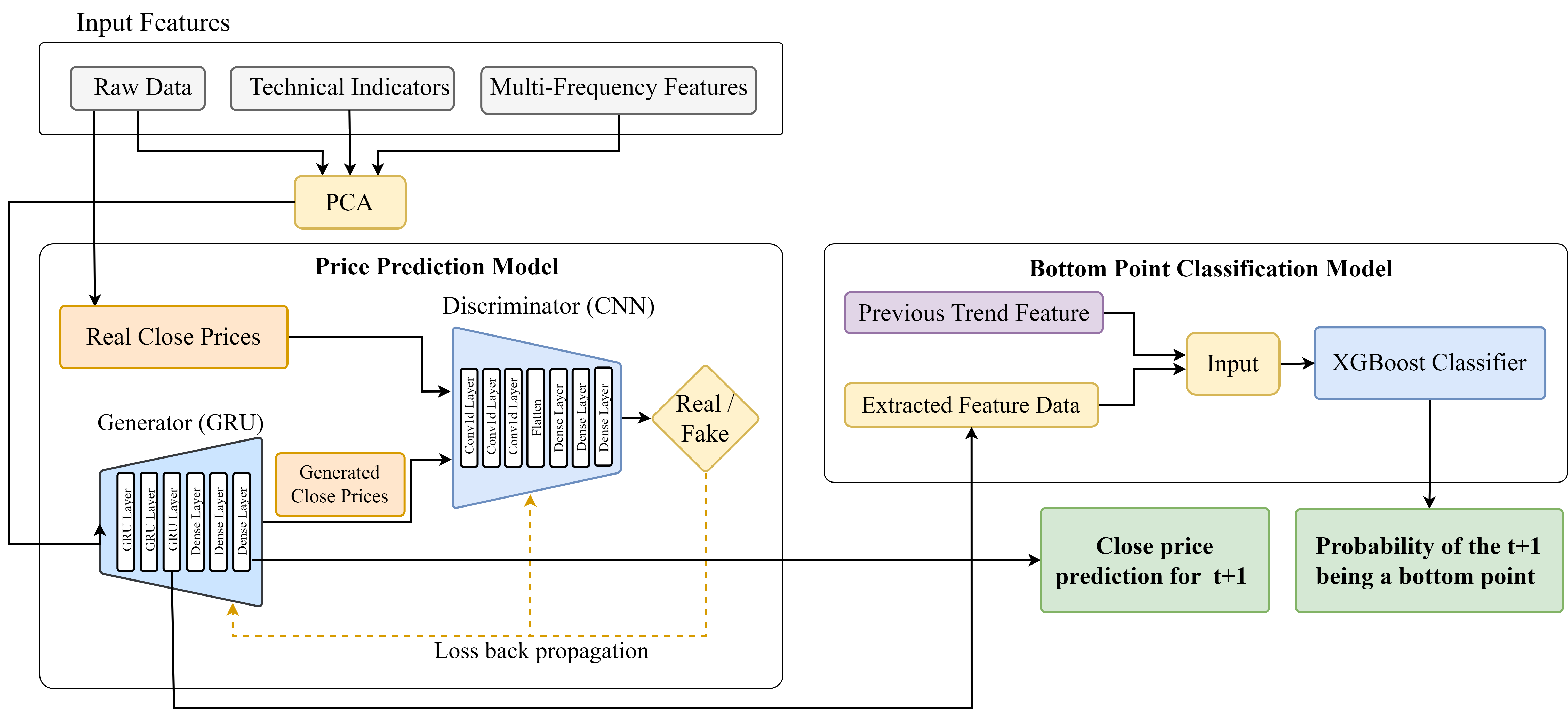 Architecture of the GAN-GRU-based forecasting framework
📄 Publication
D.M.D.K. Dasanayake, H.Y. Dilshan, H.D.K.Y. Rathnaweera, Sapumal Ahangama, Indika Perera.
“A Novel Approach for Deep Learning-Powered Forecasting of Market Bottoms in Cryptocurrency and Stock Trading”,
Proceedings of the 2023 IEEE International Conference on Big Data, Sorento, Italy.
HL7v2 Mapping Accelerator for Open Healthcare Integration
Independent Research Project at WSO2
Designed and implemented a lightweight mapping engine for the HL7v2 messaging standard, supporting healthcare data transformation into JSON and XML formats. The accelerator leverages YAML templates and integrates with WSO2 EI to enable real-time interoperability across clinical systems.
- Developed segment-to-JSON mapping logic using Java and event-driven architecture principles.
- Contributed to WSO2’s open-source healthcare integration framework.
- Explored use cases in electronic medical records (EMRs) and lab systems for real-world validation.
- Published a foundational technical blog to demystify HL7v2 and its role in modern healthcare APIs.
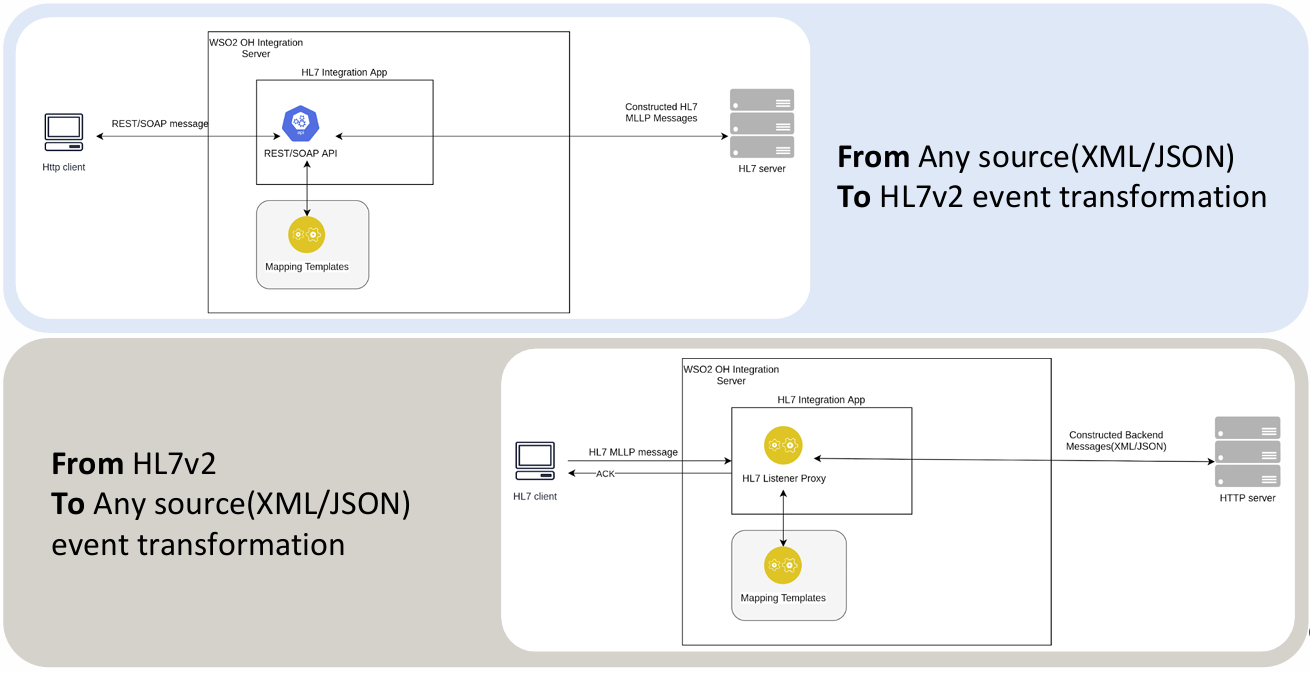 System architecture of the HL7v2 transformation pipeline